Heavy Metals Are Everywhere
In the air, metals come from vehicle exhaust, coal burning, industrial emissions, tobacco smoke, and aviation fuel. In water, they can enter through old pipes, contaminated groundwater, and treatment processes. In food, familiar examples include arsenic in rice, mercury in large fish such as tuna and swordfish, and cadmium in shellfish. On the skin, they show up in antiperspirants, cosmetics, and sunscreens. Cookware and dental materials add to the list.
Exposure is rarely one dramatic event. It is usually small amounts, repeated daily for years, and each family’s mix of sources is different. That is why we look at the whole picture rather than chasing a single metal.
Your Skin Is Not a Wall
You may have heard that about 60% of what you apply to your skin reaches your bloodstream. No single percentage holds true for every substance, but the principle is sound: skin is a route into the body. In classic human studies, absorption ranged from under 1% to nearly 50% of the applied dose, depending on the compound.[1]
Medicine relies on this. A nicotine patch delivered about 19 mg of nicotine into the bloodstream, with an average bioavailability of 82%.[2] Estrogen patches and gels work the same way, producing measurable blood estradiol levels, although the amount varies widely between women.[3] Medicated lotions and creams depend on the same pathway.
Metals can make this trip as well. In one human experiment, 1.3 mg of 4.4 mg of lead applied to the skin was absorbed within 24 hours.[4] Absorption depends on the metal and its form, but daily, repeated use adds up.
Sunscreen is a good example. Many sunscreens contain zinc oxide. Zinc is an essential nutrient, yet a human tracer study found that small amounts of zinc from sunscreen passed through the skin into the blood and urine.[5] Rat studies using injected zinc oxide nanoparticles have shown dose-dependent stress on the liver and kidneys,[6] which is why we pay attention to what families apply every day.
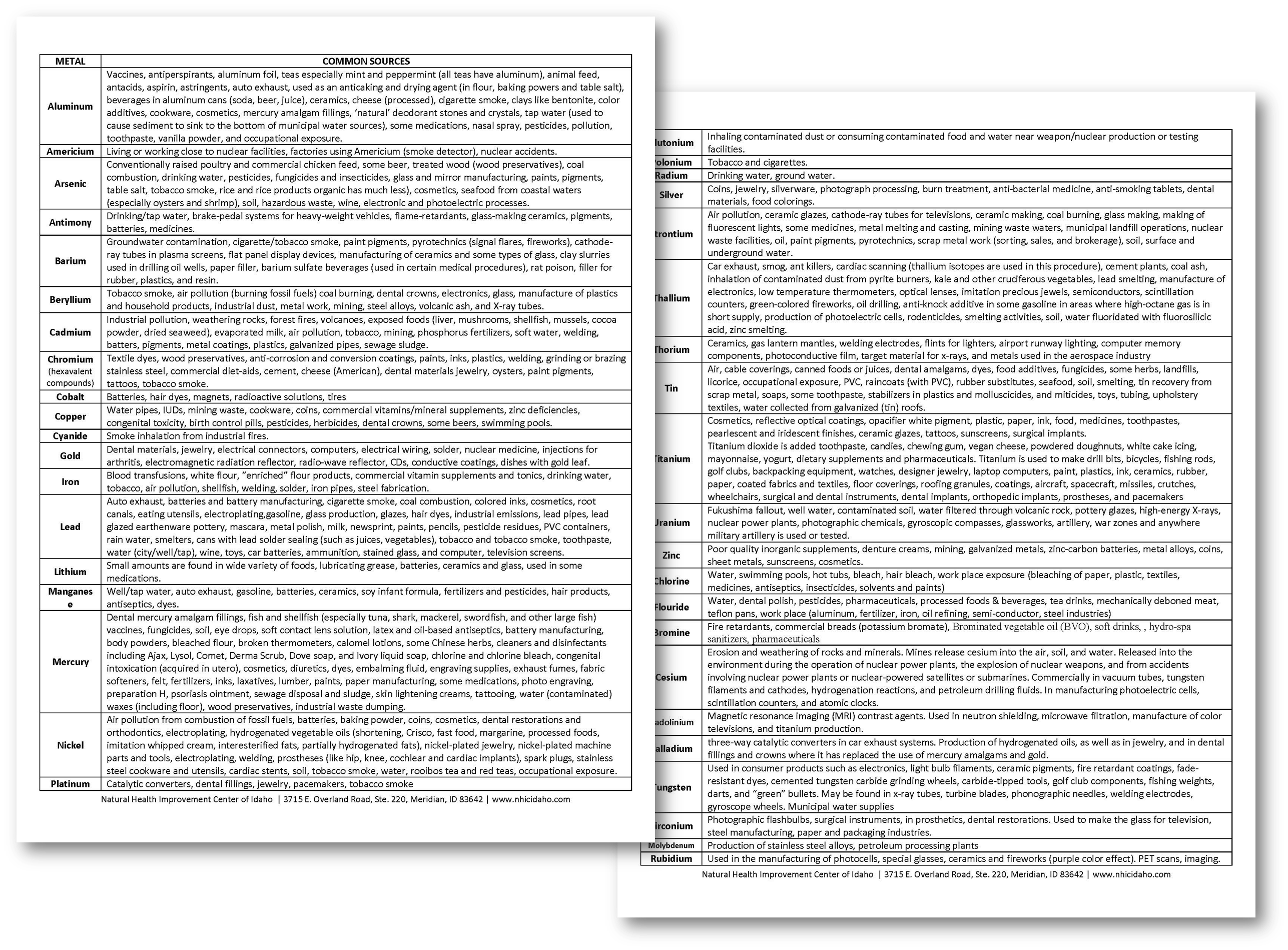
Common Sources of Heavy Metals
Here are the most common sources by metal. Click the image to open the full printable chart.
Where Metals Settle Matters
Heavy metals can create different health challenges depending on where they deposit in the body. Three examples stand out.
Aluminum. Aluminum salts are the active ingredient in many antiperspirants, and researchers have raised concerns about their role in breast tissue.[7] One case-control study found higher aluminum levels in breast tissue from women with breast cancer, along with higher risk among women who used underarm products several times a day from a young age.[8] The evidence is mixed: an earlier study found no increased risk,[9] and a small tracer study measured very low absorption from a single application.[10] In the brain, a meta-analysis of eight studies linked chronic aluminum exposure to 71% higher odds of Alzheimer’s disease.[11] These studies show association, not proof of cause, but they give us good reason to reduce exposure.
Fluoride. Fluoride is found in tap water and toothpaste. A 2025 meta-analysis of 74 studies found that higher fluoride exposure was associated with lower IQ scores in children, although the data were less certain at drinking water levels below 1.5 mg/L.[12]
Lead. Small piston-engine aircraft still burn leaded fuel, and that lead settles onto surrounding neighborhoods. Children living closest to these airports have higher blood lead levels, and levels rise with air traffic.[13][14] That matters because lead is a confirmed neurotoxin: a pooled analysis of 1,333 children linked higher blood lead to lower IQ, even at low levels.[15]
Simple Ways to Lower Your Exposure
You cannot avoid every source, but a few changes reduce your daily load:
- Filter your drinking and cooking water.
- Read the labels on antiperspirants, cosmetics, and sunscreens.
- Replace aluminum cookware and foil where you can.
- Choose smaller fish and vary your rice and grains.
- Check older homes for lead paint and lead pipes.
Why Proper Chelation and Detox Matter
Mobilizing metals is only half the job. They must also leave the body. If the liver and kidneys are not ready, stirred-up metals have nowhere good to go, so sequence and support are essential.
Here at our clinic, we use specialized food and herbal formulas to support each stage of this process:
| Support Area | Formulas We Use |
|---|---|
| Heavy Metal Chelation | Parotid PMG, ChelaCo, Calcium Lactate, Organically Bound Minerals, Trace Minerals-B12, Zinc Chelate |
| Liver Detoxification Support | Livaplex, SP Green Food, SP Cleanse, LivCo, Livton Complex, Hawthorn, Milk Thistle Forte |
| Kidney Detox Support | Arginex, A-C Carbamide, Renafood, Protefood |
Your program is individualized, so please work with us rather than starting a detox on your own, especially if you are pregnant or nursing.
Important: If you are on a heavy metal detox and develop a rash, itching, acne, hives, or any other skin reaction, contact us as soon as possible so we can modify your program. Metals should not be leaving through your skin. The healthy routes of elimination are the stool and urine, which means we need to assess and make sure your liver and kidneys are working optimally.
How We Test for Heavy Metals
We use three tools, each offering a different window into your body:
- Hair Tissue Mineral Analysis: shows which heavy metals are being excreted through the hair.
- Diagnos-Techs TME Panel: a saliva and urine test. The urine shows how much is being excreted, while the saliva reflects what is in the tissues and being released through saliva.
- OligoScan: an in-office scan of the minerals and heavy metals in your tissues.

The OligoScan uses spectrophotometry. The handheld device is placed on four points on the palm, where it shines light into the skin and measures the light reflected back. Software compares that reading against known spectral patterns to estimate mineral and heavy metal levels in the tissues.
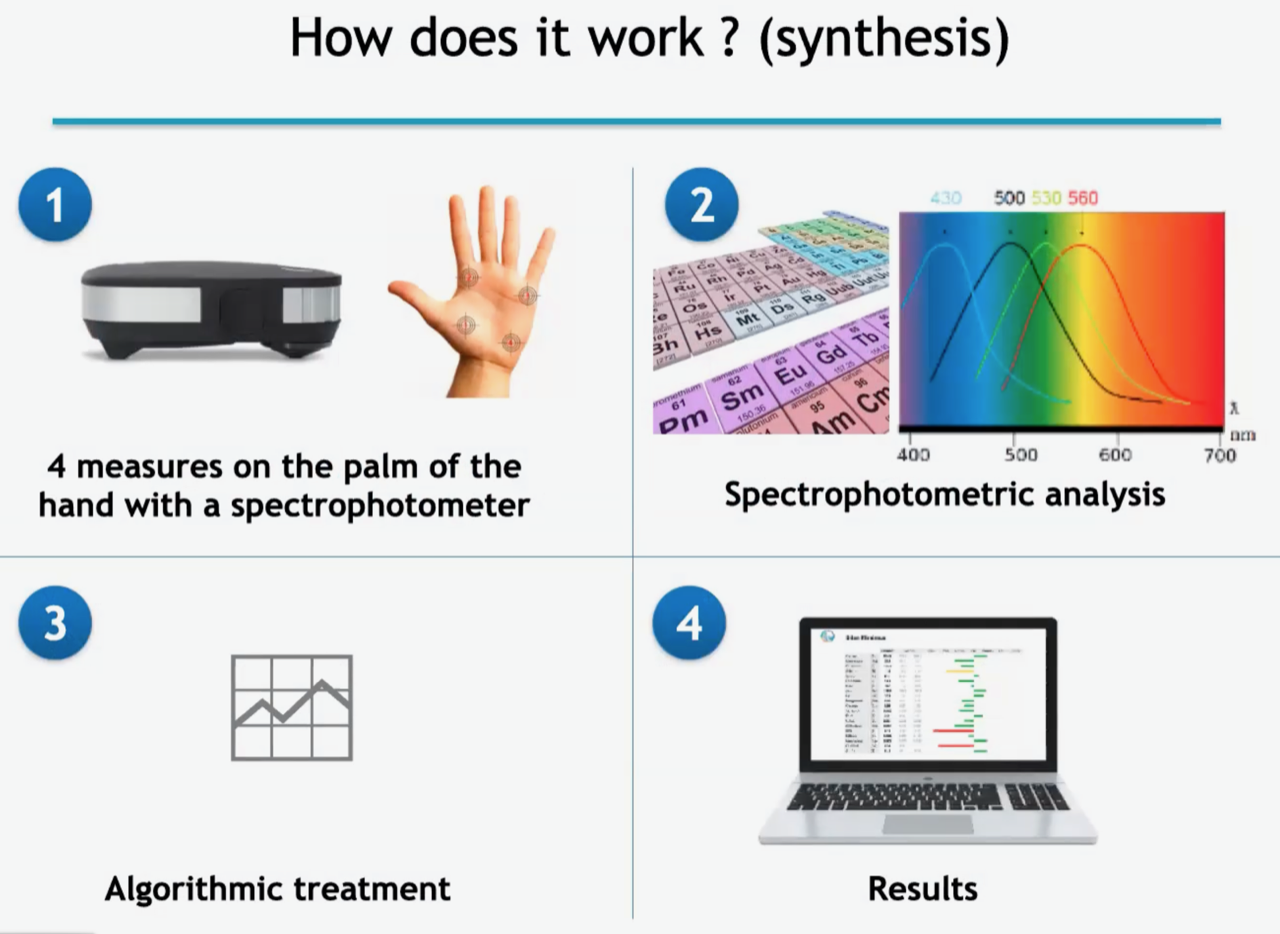
Like our saliva test, it gives us a look at what is in the tissues. The difference is speed. The scan is painless, needs no needles or samples, takes place right here in the clinic, gives results instantly, and is easy to repeat so we can track your progress. We interpret it alongside your history and other assessments.
Find Out Which Metals Are Stressing Your Body
If you are interested in investigating which heavy metals are in your tissues, book your Initial Consultation with us. We will start the assessment process to see which heavy metals your body is being stressed by, and which nutritional and herbal solutions your body needs in order to thoroughly remove them.
This article is for educational purposes and is not medical advice. These statements have not been evaluated by the Food and Drug Administration. These products are not intended to diagnose, treat, cure, or prevent any disease. Individual results vary. NHIC sells the products mentioned here.
References
- Feldmann RJ, Maibach HI. Absorption of some organic compounds through the skin in man. J Invest Dermatol. 1970;54(5):399-404. PubMed
- Benowitz NL, et al. Stable isotope method for studying transdermal drug absorption: the nicotine patch. Clin Pharmacol Ther. 1991;50(3):286-293. PubMed
- Glynne S, et al. The range and variation in serum estradiol concentration in perimenopausal and postmenopausal women treated with transdermal estradiol in a real-world setting. Menopause. 2025;32(2):103-111. PubMed
- Stauber JL, et al. Percutaneous absorption of inorganic lead compounds. Sci Total Environ. 1994;145(1-2):55-70. PubMed
- Gulson B, et al. Small amounts of zinc from zinc oxide particles in sunscreens applied outdoors are absorbed through human skin. Toxicol Sci. 2010;118(1):140-149. PubMed
- Kahil N, et al. Intraperitoneal hepatorenal toxicity of zinc oxide and nickel oxide nanoparticles in rats: a systematic review. Nanotoxicology. 2024;18(7):583-598. PubMed
- Darbre PD. Aluminium, antiperspirants and breast cancer. J Inorg Biochem. 2005;99(9):1912-1919. PubMed
- Linhart C, et al. Use of underarm cosmetic products in relation to risk of breast cancer: a case-control study. EBioMedicine. 2017;21:79-85. PubMed
- Mirick DK, et al. Antiperspirant use and the risk of breast cancer. J Natl Cancer Inst. 2002;94(20):1578-1580. PubMed
- Flarend R, et al. A preliminary study of the dermal absorption of aluminium from antiperspirants using aluminium-26. Food Chem Toxicol. 2001;39(2):163-168. PubMed
- Wang Z, et al. Chronic exposure to aluminum and risk of Alzheimer’s disease: a meta-analysis. Neurosci Lett. 2016;610:200-206. PubMed
- Taylor KW, et al. Fluoride exposure and children’s IQ scores: a systematic review and meta-analysis. JAMA Pediatr. 2025;179(3):282-292. PubMed
- Miranda ML, et al. A geospatial analysis of the effects of aviation gasoline on childhood blood lead levels. Environ Health Perspect. 2011;119(10):1513-1516. PubMed
- Zahran S, et al. Leaded aviation gasoline exposure risk and child blood lead levels. PNAS Nexus. 2023;2(1):pgac285. PubMed
- Lanphear BP, et al. Low-level environmental lead exposure and children’s intellectual function: an international pooled analysis. Environ Health Perspect. 2005;113(7):894-899. PubMed